Key takeaways:
• The 2026 PSLE AL scoring framework replaced the T-score system to resolve long-standing issues with relative scoring, unfair minor mark differentiations, and unhealthy competition.
• The AL system translates students’ raw marks into 8 Achievement Levels, ensuring easy calculation of their final PSLE scores, and dividing the students into three Posting Groups for secondary school placements.
• Students and parents looking to boost their PSLE scores can rely on Zenith, an education partner trusted by over 20,000 students for their pedagogical teaching methods, targeted drills, and specialised notes.

The Primary School Leaving Examination (PSLE) marks the first major assessment all primary school children will experience in their academic journey. Depending on their final results, children will be placed in different schools and start at different subject levels, each with varying levels of academic difficulty.

In 2021, the Ministry of Education (MOE) introduced the Achievement Levels (ALs) grading framework1 as the 2026 PSLE scoring system to replace the old T-score system. Whether you’re a young student, concerned parent, or primary school educator, understanding the AL scoring system is crucial to making decisions about future education options.

Why MOE changed the PSLE scoring system

The previous T-score system was replaced in 2021 by the Achievement Level (AL) scoring framework, which remains in place in 20262

Key problems with the T-score system

Over the years, it was apparent that the T-score grading structure had some major flaws. In its overhaul, the MOE gave the 2026 PSLE scoring system a more robust and transparent framework that aligned better with its holistic education goals. Here are some of the key issues that the AL system aimed to resolve: 

  • Relative Scoring System: Students’ raw marks were scaled relative to their peers' performance, inaccurately reflecting their actual knowledge mastery. 
  • Minor Mark Differentiations: A difference of just 1 or 2 points in exams can change a student’s T-score drastically, affecting school placement options. 
  • Unhealthy Competition: As students’ scores were based on their classmates’ results, this fostered a high-stress environment, leading to less conducive lessons. 

Why was the Achievement Level (AL) system introduced

To combat long-standing issues with the T-score system, the Achievement Level (AL) system was introduced, providing a more holistic grading framework that fully supports the MOE’s long-term educational goals. Some of the core goals of the AL include: 

  • Reducing Fine Differentiation: Minor mark differences no longer drastically affect students’ final PSLE scores. 
  • Recognising Students’ Individual Achievements: Students’ PSLE scores are not based on the country’s average and are instead graded against a set standard. 

What is the 2026 AL (Achievement Level) scoring system for PSLE?

In 2026, primary school students taking the PSLE will be assessed under the AL system. This system utilises eight tiers of bands, with each tier corresponding to a specific range of marks. AL 1 is awarded to students who achieve 90 marks and above, whereas AL 8 is attained by scoring less than 20 marks.

How to convert raw marks into AL bands

Here is an in-depth breakdown of how each raw mark range is translated into bands under the AL system. 

In cases where two or more students with the same PSLE scores are vying for the same spot in a secondary school, the MOE has specified a sequenced list of tie-breakers to help schools make unbiased and informed decisions. 

We elaborate on tie-breakers more in a section below. 

‍How to calculate your final PSLE score using the AL scoring system

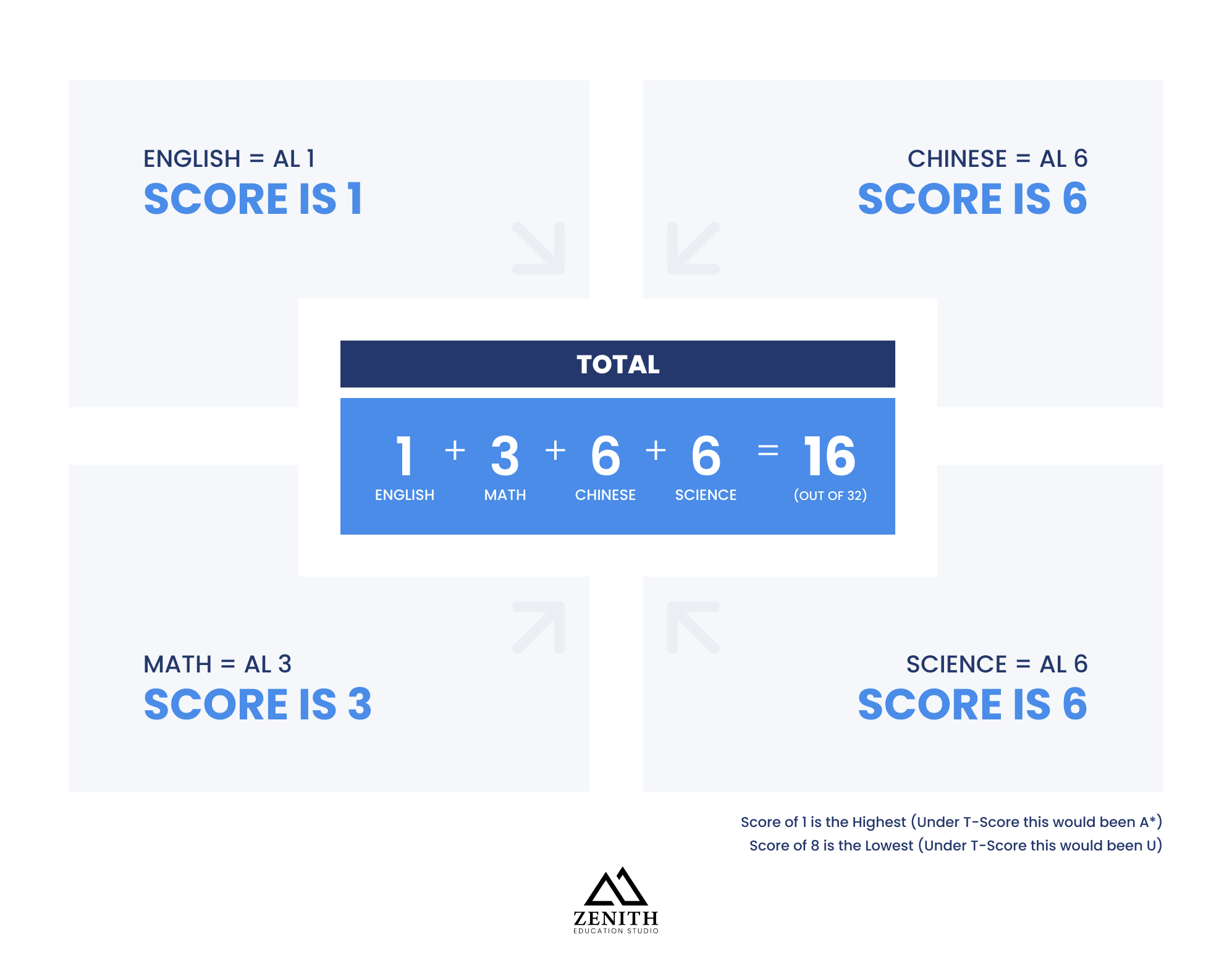
Once you’ve received exam results for all four subjects, simply add together the AL band numbers for each subject to determine your final PSLE score

PSLE scores range from 4 to 32, with 4 being the best possible score and 32 being the lowest. Here’s a quick example of how to calculate your PSLE scores: 

  • A student scored 80 in their English, 64 in Math, 49 in their Mother Tongue Language, and 92 in Science. 
  • According to the AL tiers, they have scored 3, 6, 6, and 1 points from their exams. 
  • Therefore, their total PSLE score is 16. (3+6+6+1)

How foundational level subjects are scored under the PSLE AL scoring system

Students taking foundation-level subjects will be given a different PSLE test than standard-level students, and will also be graded differently under the AL scoring system. They will receive a letter grade of A, B, or C, which corresponds to 6, 7, or 8 AL points. 

The table below shows a quick breakdown of how foundation grades are graded under the AL system. 

Here’s an example of how the PSLE score is calculated for students who have a mix of standard- and foundation-level subjects. 

  • A student who is taking foundation-level Math and English has scored 77 and 59 marks for those exams, respectively. For their standard-level subjects, Science and Mother Tongue Language, they received 91 and 80 marks, respectively. Here’s a breakdown of their AL scores for all subjects. 
    • They achieved a foundation grade of A in Math, translating to 6 AL points. 
    • They achieved a foundation grade of B in English, translating to 7 AL points. 
    • They achieved 1 AL point from their Science exam. 
    • They achieved 3 AL points from their MTL. 
  • Altogether, the student has received a PSLE score of 17. (6+7+1+3)

T-Score vs AL scoring system: How it affects your child

There are several key issues that the AL grading structure aimed to improve on from the previous T-score system. Here is a list of factors comparing the two systems.

Ease of Calculation and Understanding

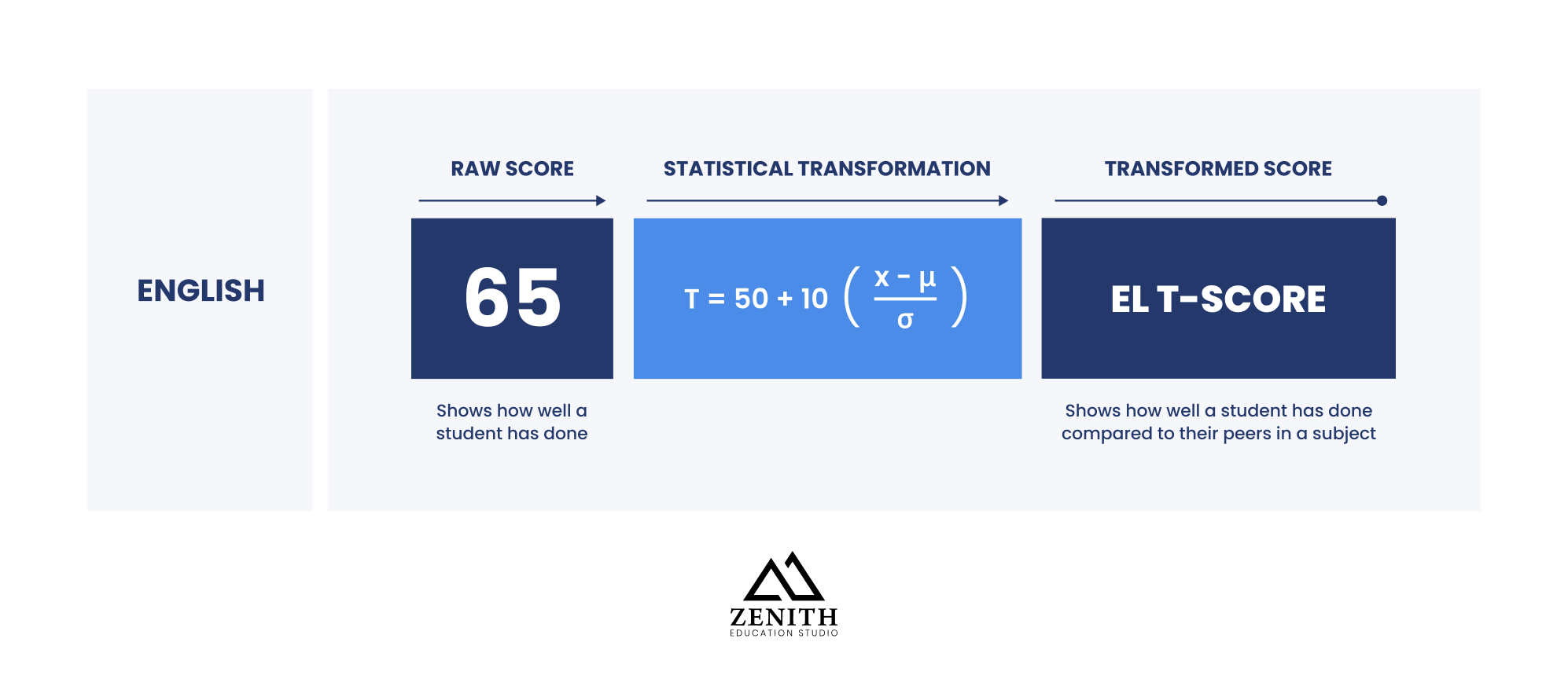
One of the key problems with the T-score system was that students could not gauge how well they did in their exams from raw subject scores alone. To find out one’s true T-score, they needed the nation’s mean scores and standard deviation to calculate how far above or below the average they achieved.

For example, a student who scored 80 marks in an exam would not know whether this was a good grade until they knew how the rest of the cohort performed. If the national average were higher, their T-score would be lowered, whereas a lower average would mean they received an excellent T-score. 

In contrast, the AL scoring system requires only the students’ raw marks to ascertain their AL points. Unlike the T-Score system’s over 200 possible aggregate scores, ALs are assigned based on only 8 tiers per subject, simplifying calculations and understanding for both students and parents alike. 

Competitiveness and Stress

Under the T-score system, students’ performances were benchmarked against all their peers in the same cohort, rather than assessing their actual depth of understanding and knowledge of the subjects. This meant that even just a difference of one or two marks in exams could drastically change their T-scores3, significantly affecting their eligibility for secondary school placement options. 

As a result, the T-score system fostered a high-stress school environment and unhealthy competition, where students felt discouraged from putting in continuous effort, as even high scorers may get a lower T-score if others perform better4

To address these issues, the AL grading structure is designed to provide a more comprehensive and transparent reflection of students’ abilities.

Notably, there is a broader range of marks in lower AL bands, where there is a wider distribution of students. In contrast, there is finer differentiation among the higher bands, allowing for more accurate recognition of strong academic performance and reducing the likelihood of tie-breakers in secondary school placements. Beyond alleviating stress and competitiveness, this system allows students to focus on their own consistent improvement.

Impact on Posting

The T-score system allowed for over 200 possible aggregate scores, whereas the AL system is designed to significantly reduce this to only 29, effectively eliminating fine-grained differentiation. Consequently, there are more chances for students to attain the same PSLE score and tie for posting options. 

To ensure fairness and transparency in secondary school placements, the MOE introduced a revised set of posting tiebreaker criteria. This list provides an objective, unbiased framework for resolving ties, helping school officials make fair decisions that best reflect students’ abilities and preferences. 

We elaborate on secondary school posting more in a section below.

Eligibility Criteria for Higher Mother Tongue Language (HMTL)

Since the implementation of the AL system, the criteria for taking Higher Mother Tongue Language (HMTL) in secondary school were also revised to be more holistic. 

Under the previous T-score system, HMTL eligibility was based on relative performance rather than actual abilities. Even during the AL transition period between 2021 and 2025, HMTL admission was still dependent on the students’ overall PSLE scores5. This meant that students who were capable of handling the academic workload of HMTL may have still been overlooked in favour of peers with stronger overall performance. 

Starting with the 2026 cohort, HMTL eligibility will no longer depend on students’ PSLE scores and will be determined solely by their MTL and HMTL scores6. Here are the most updated HMTL admission guidelines from MOE: 

  • A PSLE MTL score of AL1/AL2
  • Or an HTML score of Distinction/Merit

Two people smiling and giving thumbs-up in front of an orange background. The person on the left wears a black jacket and glasses, while the person on the right wears a white top and glasses.

Prepared for your PSLE?

Trusted by over 20,000 students since 2019, our teachers are dedicated to empowering learners with real-world skills to reach their full potential and thrive both academically and beyond the classroom.

Here at Zenith Education Studio, we offer free trial lessons, giving you the chance to experience our teaching strategies and conducive environment firsthand – but slots are limited, so sign up now!

How does the 2026 PSLE AL scoring system affect secondary school posting?

The 2026 PSLE AL system significantly reduces the range of aggregate grades students can attain, making secondary school placement easier to understand and more transparent. 

Prior to 2021, students were separated into three streams under the T-score system, which were the Express, Normal (Academic), or Normal (Technical) streams. Under the 2026 AL system, they will be divided into three Posting Groups, which determine their subject difficulty levels at the start of Secondary 17(S1). This is especially important when planning ahead for secondary school tuition, future education pathways, and potential careers. 

Students would be able to move between subject levels later on via the Full Subject-Based Banding system8

What are the new posting groups?

Based on your child’s PSLE score, they will be posted into three Posting Groups: Posting Groups 1, 2, and 3. Here are the latest updates on posting groups as of 2026: 

For students eligible for only one posting group, they will not be allowed to choose a different group until their skill levels are assessed to be more suitable for a different level9. For students eligible for two posting groups, they will be given the flexibility to choose the posting group that fits their learning pace. If no decision is made, they will be automatically assigned to the more academically challenging group10

What happens when two students with the same PSLE score apply for the same school?

According to the latest announcements from MOE, the tie-breaking criterion for students with the same PSLE score competing for the last spot in a secondary school would be as follows, in sequence: 

  1. Citizenship, with priority given in the following order: 
    1. Singapore Citizen
    2. Permanent Resident
    3. International Student
  2. Choice Order of Schools: Students who ranked the school higher on their list of choices are prioritised. 
  3. Computerised Balloting: If the criteria above are the same, computerised balloting will be used to determine who is admitted. 

What are the latest secondary school cut-off points?

While there are no standardised cut-off points (COPs) for each school, students can estimate the minimum PSLE points they will need to be eligible for their desired secondary schools by reviewing the COPs from the last year. 

Generally, top schools such as Raffles Institution and Hwa Chong Institution have higher COPs. If you’re looking for an updated list of secondary school cut-off points, we have all of the latest information on our website.

PSLE Preparation with Zenith: Proven track record of excellence

Having supported over 20,000 students since 2019, the team at Zenith has been all about helping students find their stride and crush their academic goals.

In addition to JC and secondary support, we offer a comprehensive PSLE tuition that incorporate pedagogical teaching methods, highly effective exam strategies, as well as curated notes and exam drills to help students ace their PSLE. 

As a leading tuition centre in Singapore, we believe that primary education sets students up for success beyond just scoring well in one exam, building a foundation of strong learning habits and real-world skills. With a dedicated team of teachers and curated student-centred learning environments, we provide your child with a structured, supportive, and continuous learning journey throughout their academic years. 

Slots Are Filling Fast

At Zenith Education Studio, we believe in empowering students to succeed by providing the support they need to excel. That's why we offer free trial sessions, giving you the chance to experience our teaching strategies and environment firsthand! But slots are limited, so sign up now!

References

1 https://www.moe.gov.sg/microsites/psle-fsbb/psle/main.html

2 https://www.moe.gov.sg/microsites/psle-fsbb/psle/main.html

3 https://www.moe.gov.sg/microsites/psle-fsbb/psle/changing-psle-scoring-system.html

4 https://www.todayonline.com/singapore/psle-scoring-system

5 https://www.moe.gov.sg/news/press-releases/20190725-updates-to-psle-2021-scoring-system-enabling-students-to-progress-regardless-of-starting-points

6 https://www.moe.gov.sg/secondary/schools-offering-full-sbb

7 https://www.moe.gov.sg/secondary/s1-posting/how-to-choose/what-are-posting-groups

8 https://www.moe.gov.sg/microsites/psle-fsbb/full-subject-based-banding/about-full-sbb.html

9 https://www.moe.gov.sg/secondary/s1-posting/how-to-choose/what-are-posting-groups

10 https://www.moe.gov.sg/secondary/s1-posting/how-to-choose/what-are-posting-groups