ZENITH PRIMARY, SECONDARY, & JC CRASH COURSE ARE NOW OPEN. SLOTS ARE LIMITED!
ZENITH J1 DOUBLE TRIAL CLASSES ARE NOW OPEN. SLOTS ARE LIMITED!
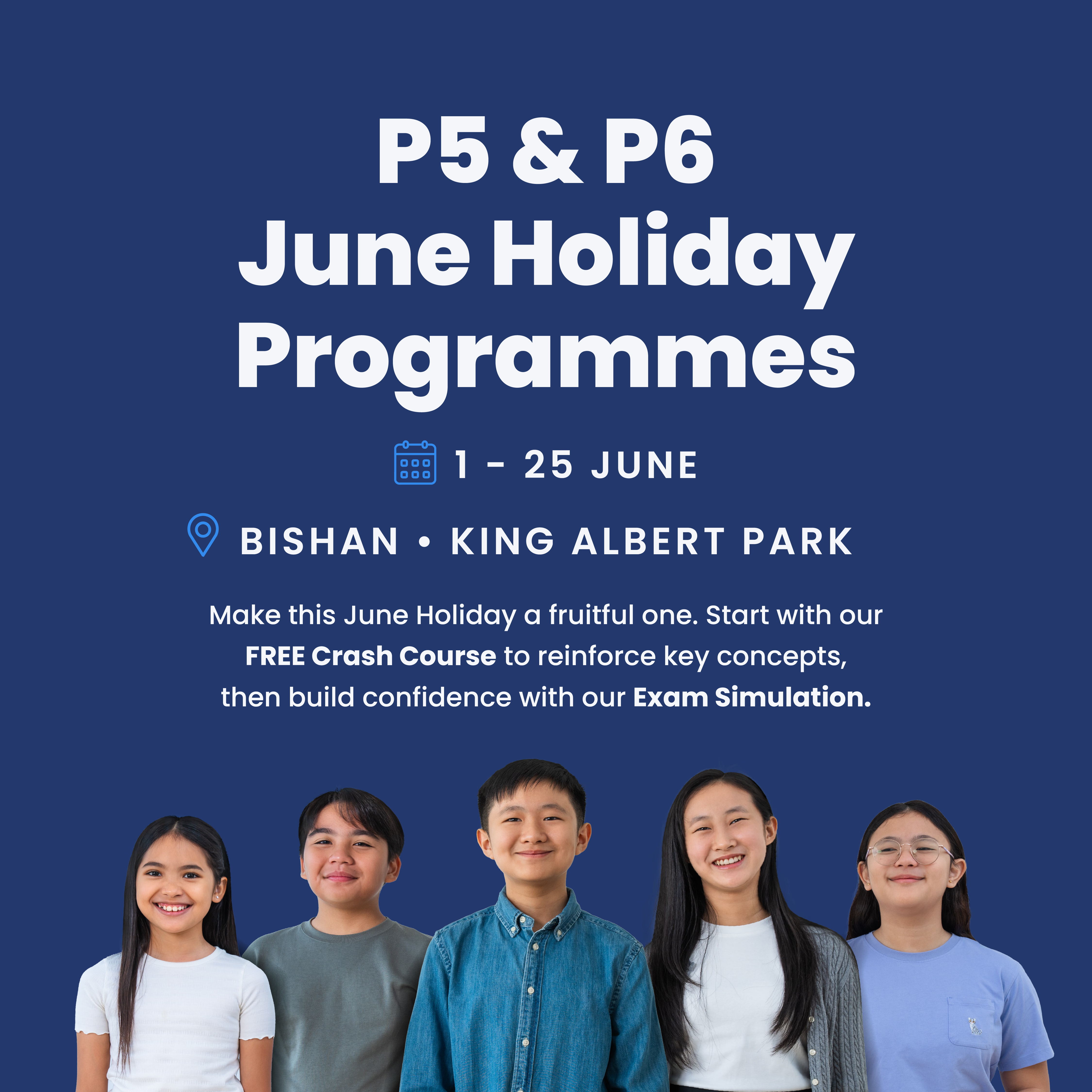
Give your child a structured head start this June with Zenith’s 2-part programme for P5–P6 students. Start with our FREE Crash Course to strengthen core concepts, then move into our Exam Simulation to apply what they’ve learnt under real exam conditions.

Trusted by over 20,000 students
By the end of Semester 1, many students may still feel unsure about certain topics. This June programme is designed to help them close those gaps and move forward with confidence. Students begin by reinforcing key concepts through our Crash Course, before progressing to an Exam Simulation where they apply what they’ve learnt in a structured, exam-like setting. This complete approach ensures they are not only clear on concepts, but also prepared to handle questions, manage time, and perform better in Semester 2.


Slots are filling fast!
Top student community
Proven notes & pedagogy
Educators: MOE award winners, valedictorians, and Dean’s List recipients
Trusted by over 20,000 students
Zenith’s June Holiday Programmes are designed to prepare your child for the upcoming exams and PSLE.
Start off with our free Crash Course, where our experienced tutors will be going through key PSLE topics, answering techniques and common pitfalls.
After the crash course, sign up for our Exam Simulation, where your child will take a mock paper in an exam environment, to build their PSLE confidence.
Students who want to catch up on weaker areas
Students who want to strengthen their subject foundation
Parents looking for quality teaching and accountability
P5 Math
P5 English
P5 Science
P6 Math
P6 English
P6 Science
P5 Math
P5 English
P5 Science
P6 Math
P6 English
P6 Science
Fractions are one of the highest-weightage and most error-prone topics in primary mathematics exams. They frequently appear in complex word problems, and many students lose marks not because they lack basic knowledge, but because they struggle to analyse the relationships involved and select the right strategy when questions look unfamiliar.
This focused crash course is specially designed to help students decode fraction word problems with confidence and clarity, even when questions are presented in new or challenging formats.Through a diagnostic mini quiz, guided practice, and explicit strategy teaching, students will learn how to:
🧠 Identify the underlying structure of fraction problems rather than rely on guesswork
🔍 Apply key heuristics such as: Part–Whole Relationship, Equating Numerators, Number–Value Concept
⚠️ Avoid common mistakes that lead to careless errors and incorrect methods.
More than just content revision, this workshop equips students with problem-solving frameworks, clear thinking habits, and exam strategies that are essential for tackling fraction questions accurately and confidently.
Experimental-based questions are one of the most challenging and fast-growing components of the PSLE Science paper, accounting for 7 to 15% of total marks and appearing more frequently in recent years. Many students lose marks not because they don’t know the content but because they do not begin early in spotting the different types of experiment question that will come out for PSLE, hence they struggle to interpret experiments and phrase their answers with the necessary keywords.
This focused crash course is specially designed to help students decode experimental questions, no matter the topic tested, with confidence and accuracy. Starting early gives student a longer runway to learn and practice tackling experimental questionsThrough guided practice and clear strategies, students will learn how to:
🔍 Analyse experiments systematically, including identifying changed and measured variables in the questions easily.
🧠 Apply templates (i.e. Aim, Relationship, Hypothesis, Conclusion, and Control Set-up) to different setups, even when questions look “new” or tricky.
⚠️ Avoid common mistakes that cost students marks in experimental questions.
More than just content revision, this workshop aims to equip students with exam techniques, and question-analysis strategies that are essential for today’s PSLE Science paper!
Many Primary 6 students lose marks because their climax is rushed, flat, or unclear, reducing the impact of their compositions.
This crash course helps students write strong, memorable climaxes by focusing on key elements that make the ending exciting and meaningful.Students will learn how to:
🧠 Understand the role of the climax in driving tension and meaning
✍️ Build impact with clear actions, emotions, and consequences
⚠️ Avoid common pitfalls such as abrupt endings or irrelevant events
Beyond content, this workshop equips students with planning techniques and strategies that elevate the overall quality and impact of their compositions.
Non-routine questions are an increasingly important component of primary mathematics exams, yet they are often less extensively covered in regular practice. Many students lose marks not because they lack foundational skills, but because they feel overwhelmed when familiar methods no longer apply and are unsure how to begin.
This focused crash course is designed to help students approach unfamiliar and non-routine questions with clarity and confidence, even when questions look intimidating or are allocated higher marks.Through guided exposure and structured problem-solving strategies, students will learn how to:
🔍 Interpret questions carefully and understand what is truly being asked🧠 Identify key information and discard irrelevant details
⚙️ Apply logical and flexible strategies when standard methods do not work
⚠️ Avoid panic and common traps in unfamiliar question types
More than just practice, this workshop equips students with thinking frameworks and exam strategies that enable them to stay calm, reason clearly, and tackle non-routine questions effectively during exams.
Experimental-based questions are one of the most challenging and fast-growing components of the PSLE Science paper, accounting for 7 to 15% of total marks and appearing more frequently in recent years. Many students lose marks not because they don’t know the content but because they struggle to interpret experiments and phrase their answers with the necessary keywords.
This focused crash course is specially designed to help students decode experimental questions, no matter the topic tested, with confidence and accuracy.
Through guided practice and clear strategies, students will learn how to:
🔍 Analyse experiments systematically, including identifying changed and measured variables in the questions easily.
🧠 Apply templates (i.e. Aim, Relationship, Hypothesis, Conclusion, and Control Set-up) to different setups, even when questions look “new” or tricky.
⚠️ Avoid common mistakes that cost students marks in experimental questions.
More than just content revision, this workshop aims to equip students with exam techniques, and question-analysis strategies that are essential for today’s PSLE Science paper!
At Zenith, we collect fees on a Monthly basis.
The monthly payment advice is emailed to the registered email address within the first week of each month.
Fees must be paid within the same month.
Fees are payable throughout the year, including:
- School holidays
- Public holidays
** Zenith Education Studio reserves the right to alter fees without prior notice.
Should students choose to withdraw from classes, you must inform your tutor(s), contact our finance team (8822 3770) and submit a withdrawal form at least 1 month before your final class (4 final lessons). During the 4 lesson notice period, students must continue attending classes.
- Deposits will be refunded in the final month of classes after all outstanding fees have been cleared.
- Withdrawal without proper notice will result in forfeiture of the deposit.
Lessons are conducted physically by default, unless otherwise stated. Lessons are 2 hours per session, conducted once a week. Months leading up to students' major examinations, additional lessons will typically be provided during the holiday period.
Online lessons are scheduled at certain times to enhance flexibility and coverage, such as: Chinese New Year, Last week of Term 2, First week of Term 3, September and December holidays
Upon registration, students will be provided access to Zenith's Learning Management System (LMS) to access all online resources
** Zenith Education Studio reserves the right to conduct lessons online if necessary.
Yes! Do follow our social media pages to be kept up to date with our ongoing promotions and terms! However, do note that discounts offered by Zenith are non-stackable.
Students are eligible for only one discount or promotional benefit at any given time. This includes, but is not limited to; multiple-subject discounts, sibling discounts, and referral bonuses, which may not be applied concurrently.
All fees listed are nett price and we do not charge any material or registration fees.
We ask that students inform their respective tutors at least one week in advance if they are unable to attend a scheduled lesson, providing a valid reason for their absence.
We request that students attend their make-up lesson within the same week, by joining another available class. Please note that make-up lessons cannot be carried over to the following week.
If attending the make-up lesson is not possible, students will be provided with a complete recording of the lesson via Zenith's in house Learning Management System. Students are also encouraged to arrange a complimentary 1-1 consult with their tutor after watching the recording to clarify any questions and concepts taught during the lesson. The recording will be equivalent to attending the scheduled lesson.
Educators at Zenith wholeheartedly believe in the effectiveness of our group teaching in getting you that coveted A for your examinations. We do not provide 1-1 tuition, but often provide 1-1 consults to students FREE OF CHARGE, especially nearing examination periods, subject to the tutor’s availability. Students can also arrange to see teachers before and after lessons for free consultations.
Zenith is conducted fully in physical classrooms. Students attend scheduled lessons in a structured, classroom-based environment that mirrors real exam conditions. This helps students stay focused, build discipline, and learn effectively alongside their peers