O-Level Biology can be pretty challenging with its choke load of content and complex application questions. However, fret not, because one of Singapore’s top O Level Biology tuition centres is here to save the day! Here at Zenith, we have a proven track record of 85% distinctions amongst our upper secondary students across all subjects. Today, we have compiled a few tips for you to heed to streamline your learning process if you want to secure your coveted distinctions. Over the years, we have analysed the common mistakes students often make during their exams and have come up with the best ways for you to secure your distinction!
#1: Know your content well
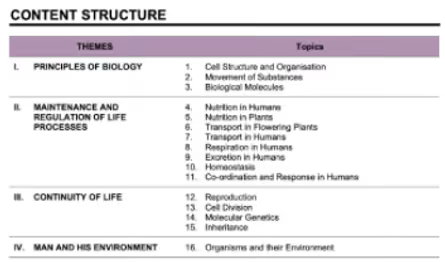
This point is crucial and (essentially) mandatory. Many students often find Biology content overwhelming even at the O-Levels (Fig 1.)! According to the SEAB content overview, there are a total of 4 themes and 16 chapters in total for the pure Biology O-Level syllabus.
Fig 1. SEAB O-Level Pure Biology content overview
Across the three O-Level Biology papers; paper one, paper two, and paper three, questions will test your knowledge of content, which is why you need to be extremely familiar with it. Questions in paper one are generally more direct, however, questions in papers two and three tend to be trickier. Paper one consists solely of multiple-choice questions while paper two would include free-response questions and paper three would be your practical assessment (Fig 2.)!
Fig 2. SEAB Pure Biology scheme of assessment
Examiners like to test the candidate’s application skills in paper two, expecting you to apply your textbook knowledge to real-life scenarios. This is where you need to be well-versed in the entire syllabus in order to make the correct connections and mold your content to the context of the question. In paper three, which is your Biology Practical, examiners might give you experiments that seem foreign, so you must have a solid foundation over your Biology content in order to link the appropriate Biology concepts to various questions. Remember, all your answers must be supported by biological theories.
Study according to the SEAB content guidelines
Here is a neat trick that many students do not employ when crafting their revision plans. TheSEAB board actually publishes content requirement guidelines for each and every examinable subjecton their website. You can find it here: Pure Biology syllabus!
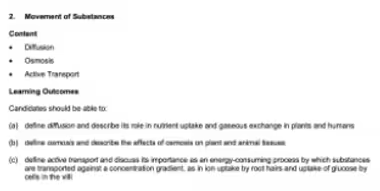
These guides will be paramount to your success in the O-Level examinations and can help in advising you on how to prioritise various topics. Students often feel overwhelmed with content in O-Level Biology and are often unable to pick out the key information needed. This is why you should refer to the guidelines when doing up your notes (Fig 3.)! This is a foolproof way to ensure effective and streamlined studying because it not only gives your notes structure but enables you to double-check that you’ve covered all the essentials.
Fig 3. Sample of SEAB content guidelines for O-Level Pure Biology (Movement of substances)
Hwever, if you are still unsure that you’ve covered all grounds in your notes or are afraid that you may have phrased certain definitions or processes wrongly, Zenith has just the solution for you! Here at one of the best secondary school and IP tuition centres in Singapore, our tutors personally compile concise sets of notes weekly, just for you.
Having many years of experience, you can expect our experttutors to be extremely familiar and up-to-date with the prevailing SEAB guidelines. Apart from our top-tier notes, our tutors also provide students with succinct summary sheets and occasionally, exam “cheat sheets” to streamline their learning process. These sheets comprise key ideas, processes, and formulas, making them a must-have for students. They are not only a good overview of each chapter and/or theme, but also act as the perfect tool for a quick recap before your O-Level Biology Examination.
Mind Maps
Another effective method of studying is by constructing mind maps! We have previously written an article on how to do so, which you can check out here. Mind maps essentially simplify each chapter by showing you the larger overview of processes. It will aid you in breaking down various concepts and will enable you to see the links between various topics/concepts/processes better. Go through your textbook, highlight important concepts and then try to construct these mind maps with minimal referencing. This not only tests your comprehension of certain concepts but your memory of them as well!
#2: Practice, Practice, and Practice
The ten-year series (TYS) is an extremely handy tool. You may be tempted to skip out on doing the past year papers from the TYS. However, this is where you will be making a grave mistake. O-Level Biology papers are big on repetition, meaning examiners like to recycle questions. You will likely find repeated questions in your papers, and imagine what a relief it will be to find questions that you have previously attempted. (One of our students found 4 repeated questions in her MCQ paper!) Aside from the fact that examiners might reuse questions, doing the TYS will enable you to practise doing questions under time constraints while you polish up your answering skills. You can even identify any remaining doubts or misconceptions you have as you go through the paper. You must remember to complete your TYS papers under timed conditions! This means that you should aim to complete the paper in one sitting, in a quiet environment without referring to your notes. You can also try out other schools’ exam papers or common test papers. These tend to be more difficult, but challenging yourself can help to refine your thinking process and sharpen your content knowledge!
During the examination season, many students scramble to find a good study space. However, many of our students really enjoy heading down to our centres to get some mugging done. All our four centres have designated study areas with air-conditioning, speedy internet connection, and fully stocked snack bars for you (Fig 4.).
Fig 4. Our snack ba
After you attempt various practice papers, do make it a point to set up consultations with your tutor to clarify doubts as well. It is good practice to run your exact answers by your tutors as it is an excellent way to check your phrasing styles, question analysis, and to clear any misconceptions in the process. Learning through mistakes is actually one of the most effective ways of improving! Keep track of your score for each paper and you will notice yourself doing better and better for each paper, as long as you make a consistent effort in the subject. If you are too shy to approach your school tutors, our friendly tutors here at Zenith are always ready to answer your questions. Here, we believe in combining modern and traditional teaching methods to ensure effective learning that is conducive to your critical thinking process. The Zenith experience comprises both online and in-person consultations any time of the week as long as our tutors are available. If you prefer to clarify your doubts over text, our tutors are also happy to oblige!
#3: Do well for paper three
Your practical exam takes up about 20% of your total O-Level Pure Biology grade (Refer to fig 2.). This makes it crucial for you to really score for this section in order to set yourself apart from your peers. O-Level practical papers often consist of experiments with the same key ideas like photosynthesis, respiration, food test, and the movements of substances. Before your O-Level practical examination, familiarise yourself with these few topics, especially with the experimental setup, procedure, and common forms of errors. Here are a few common ideas that may be tested:
Photosynthesis
Factors affecting the rate of photosynthesis
Light intensity
Chlorophyll concentration
Temperature
Respiration
Factors affecting the rate of respiration
Temperate
Enzyme concentration
Substrate concentration
Food tests
Benedicts Test: Presence of reducing sugars
To 1cm3 of the sample, add 1cm3 of Benedict’s solution (1 : 1)
Mix well
Heat in a boiling water bath for 3 minutes, timing with a stopwatch
Observe colour change
Biuret Test: Presence of Protein
To 1cm3 of the sample, add 1cm3 of aqueous NaOH (1 : 1)
Mix well using a stirrer
Add Copper II Sulphate solution drop by drop, shaking the test tube after each drop
Observe colour change
Emulsion Test: Presence of Fat
Crush food sample with 3cm3 of ethanol using a mortar pestle
Pour all contents into test test
Shake the mixture thoroughly
Allow solids to settle for 3 minutes
Decant the ethanol slowly into another test tube with 2cm3 distilled water
Observe for presence or absence of white emulsion
Iodine Test: Presence of Glucose
On a white tile, use a dropper to drop 3 drops of sample
Using a different dropper add 1 drop of iodine
Observe colour change
#4: Score for your multiple-choice questions
In Pure Biology, multiple-choice questions make up 30% of your total grade. Given that multiple-choice papers are always hosted at the end of the O-Level examination season, many students end up chucking away their books and celebrating prematurely. However, this is a grave mistake! You should treat paper 1 of equal importance because just like practical, it will help to set you apart from your peers and 30% of your total grade is a hefty weightage! Moreover, you will have a week to prepare due to the one-week gap between the last written paper and your multiple-choice paper. As mentioned earlier in the article, examiners like to recycle questions for the O-Level Examinations, making it all the more important that you redo your TYS papers during that break to refresh your memory from previous sessions. As always, practice papers should be done in one sitting in an appropriate setting.
#5: Addressing common misconceptions
It’s inevitable, certain challenging chapters may have you feeling completely lost and muddled! However, it’s important to clear any misconceptions and conceptual errors before they snowball. By cultivating the habit of asking doubts, and resolving them, you’ll develop critical thinking skills. For instance, many students tend to feel confused on the topic of “Transport in Humans – Circulatory system”, due to the intricate processes and components involved. We’ll be touching on just one of these common misconceptions, but please remember to clarify other doubts you have with your tutors!
Clotting
Blood clots seal the wound, preventing excessive loss of blood and preventing foreign particles from entering the bloodstream.
When blood vessels are damaged; damaged tissues and blood platelets release the enzyme thrombokinase.
Thrombokimase converts prothrombin to thrombin in the presence of calcium ions. Thrombin is an enzyme that catalyzes the conversion of soluble proteins fibrinogen to insoluble threads of fibrin.
Fibrin entangles blood cells and the whole mass forms a clot/scab.
When thrombokinase is released, it neutralizes heparin, an anti-clotting substance found in blood, so that clotting can take place.
Phagocytosis
The process of engulfing/ingesting foreign particles such as bacteria by white blood cells.
Phagocytes engulf bacteria by flowing over them and enclosing them.
Ingested bacteria will be digested in phagocytes. In the process, some of the phagocytes die, dead phagocytes and dead bacteria make up pus.
Antibody production
When bacteria and viruses enter the bloodstream, they stimulate the lymphocyte to produce antibodies.
Antibodies: destroy bacteria by attaching to them and causing the bacterial surface membrane to rupture and/or cause bacteria to clump together or agglutinate so they can be easily ingested by phagocytes.
The cardiac cycle
Right:
Deoxygenated blood is returned to the right atrium by the venae cavae. Blood from other parts of the body (excluding lungs) is returned by the inferior vena cava
When the right atrium contracts, pressure in the right atrium is higher than the pressure in the right ventricle, causing the tricuspid valves to open and blood to flow from the right atrium to the right ventricle.
When the right ventricle contracts, blood pressure forces the tricuspid valves to close, to prevent the backflow of blood from the ventricle to the atrium. The chordae tendinae present flaps from being inverted into the atrium. Blood leaves the right ventricle through the pulmonary arch which splits into two.
Left:
Oxygenated blood is brought to the left atrium by the pulmonary veins.
When the left atrium contracts, pressure in the left atrium is higher than the pressure in the left ventricle, causing the bicuspid valves to open and blood to flow from left atrium to the left ventricle.
When the left ventricle contracts, blood pressure in the left ventricle causes the bicuspid valves to close, preventing the backflow of blood into the left atrium. Chordae tendineae prevents flaps from reverting into the left atrium. Blood leaves through the aorta.
From the aorta, blood is distributed to all parts of the body. The aorta has semilunar valves to prevent the backflow of the blood into the left ventricle.
The small coronary articles emerge from the aorta, bringing oxygen and nutrients to heart muscles.
Here at Zenith, we care about your well-being. We believe that academics is only half the story, which is why we go the extra mile to ensure the welfare of our students. We know that the national examinations can take a physical and mental toll on students, so we aim to brighten up your days with monthly welfare sessions (Fig 5.)! We have also partnered up with some food and beverage stores to give our students extra perks and discounts! Zenith hosts free trial classes for students who are keen to try our classes out. Don’t miss out on your chance to enquire more or sign up today!
Fig 5. Our welfare for the month of February (2022)







.webp)